


Scrub pants are available in several distinct silhouettes, and the best style depends on fit preference, movement demands, storage needs, workplace expectations, and footwear. Joggers provide a close ankle fit, tapered pants narrow gradually without a cuff, cargo pants emphasize storage, straight-leg pants offer a traditional silhouette, and flare styles create more room below the knee.
No single scrub pant style is best for every healthcare professional. A well-chosen pair should remain secure at the waist, allow comfortable movement through the hips and knees, provide an appropriate inseam, and offer only as much pocket storage as the wearer actually needs.
Quick Answer
The major scrub pant styles differ in practical ways:
- Jogger scrub pants taper closely toward the ankle and usually have knit or elastic cuffs.
- Tapered scrub pants narrow gradually from the thigh toward the ankle without necessarily using a cuff.
- Cargo scrub pants prioritize additional thigh and utility pockets.
- Straight-leg scrub pants maintain a relatively consistent width from the thigh toward the hem.
- Flare or bootcut scrub pants widen below the knee and provide more room around the lower leg.
- Wide-leg scrub pants provide the greatest amount of lower-body fabric and create a more relaxed silhouette.
The correct choice should be based on body proportions and job demands rather than fashion alone.
Why Does Scrub Pant Style Matter?
Healthcare professionals may spend considerable time walking, standing, bending, stretching, and changing position during a workday. The U.S. Bureau of Labor Statistics notes these physical demands specifically for registered nurses, making garment mobility and fit practical considerations rather than purely aesthetic ones. (Bureau of Labor Statistics)
Pant style affects:
- Freedom around the hips and thighs
- Knee movement
- Lower-leg room
- Airflow around the legs
- Pocket placement
- Weight distribution
- Interaction with footwear
- Pant length
- Professional appearance
Two pairs of pants in the same numerical size can perform very differently if one is a slim jogger and the other is a relaxed straight-leg design.
Professionals browsing scrub pants for women should therefore consider the entire silhouette in addition to waist and hip measurements.
What Should Be Checked Before Choosing a Scrub Pant Style?
Before comparing joggers, cargo pants, and other cuts, establish several basic fit requirements.
Waistband
Common scrub-pant waistbands include:
- Full elastic
- Drawstring
- Elastic and drawstring
- Wide knit or yoga-style waistband
- Flat-front waistband
- Partial elastic panels
The waistband should remain secure while standing, sitting, and walking without creating excessive pressure.
Rise
Rise describes the distance and fit between the waistband and crotch.
Common descriptions include:
- Low rise
- Mid rise
- Natural rise
- High rise
The terminology can vary among manufacturers, so the actual garment or size chart is more useful than the label alone.
Hip and Thigh Room
Scrub pants should provide enough room for:
- Sitting
- Walking
- Bending
- Squatting
- Raising the knee
- Climbing stairs
A close-fitting silhouette should still permit these movements without remaining under constant fabric tension.
Inseam
Inseam determines where the pant hem or cuff falls relative to the leg and footwear.
Available lengths may include:
- Petite
- Short
- Regular
- Tall
The ideal length can change depending on whether the pant is a jogger, straight-leg style, or flare.
Pocket Needs
Before selecting a cargo or multi-pocket design, identify what is actually carried.
Useful pocket items may include:
- Pens
- Small notebook
- Phone when permitted
- Identification accessories
- Keys
- Small approved work tools
More storage is useful only when the extra pockets remain comfortable and secure.
What Are Jogger Scrub Pants?
Jogger scrub pants have a tapered leg that ends in a fitted ankle opening, usually with knit, ribbed, or elastic cuffs.
The style takes inspiration from athletic apparel while retaining the fabrics, pockets, and professional construction associated with medical workwear.
Advantages of Jogger Scrub Pants
Joggers can provide:
- Reduced loose fabric around the ankle
- A modern silhouette
- Secure lower-leg fit
- Easy visibility of footwear
- Less chance of a wide hem dragging
- A streamlined appearance
They may appeal to professionals who prefer a close-fitting lower leg.
Potential Drawbacks
Joggers may feel restrictive when:
- The calf is too narrow
- The cuff is too tight
- The inseam is too short
- The thigh fit is excessively slim
- The rise does not match the wearer
A jogger can fit correctly around the waist and still be uncomfortable below the knee.
Who May Prefer Joggers?
Joggers may suit healthcare professionals who:
- Walk frequently
- Prefer athletic-style footwear
- Want less material near the ankle
- Prefer contemporary scrub styling
- Do not need a loose lower-leg fit
How Should Jogger Cuffs Fit?
The cuff should rest around the ankle without:
- Digging into the skin
- Leaving strong pressure marks
- Sliding continually upward
- Twisting
- Restricting ankle movement
When sitting, the cuff will usually move somewhat higher on the leg. The rise should not be so extreme that a large portion of the lower leg becomes exposed unintentionally.
What Are Tapered Scrub Pants?
Tapered pants gradually become narrower from the thigh toward the ankle.
Unlike joggers, they typically end in a conventional hem instead of a fitted cuff.
Healthcare professionals considering tapered scrub pants may prefer them when they want a streamlined leg without the athletic appearance of an ankle cuff.
Advantages of Tapered Scrub Pants
Tapered pants can offer:
- A clean professional shape
- Less lower-leg fabric than straight styles
- Greater ankle freedom than many joggers
- Easy pairing with different work shoes
- A balance between contemporary and traditional styling
Potential Drawbacks
A narrow taper can create tightness through:
- Thighs
- Knees
- Calves
The problem may become more noticeable while sitting or climbing stairs.
Who May Prefer Tapered Pants?
They may work well for professionals who:
- Want a modern silhouette
- Prefer a standard hem
- Find straight-leg pants too loose
- Find jogger cuffs uncomfortable
- Need a style compatible with both athletic and traditional footwear
Jogger vs Tapered Scrub Pants: What Is the Difference?
Joggers and tapered pants are sometimes confused because both narrow toward the ankle.
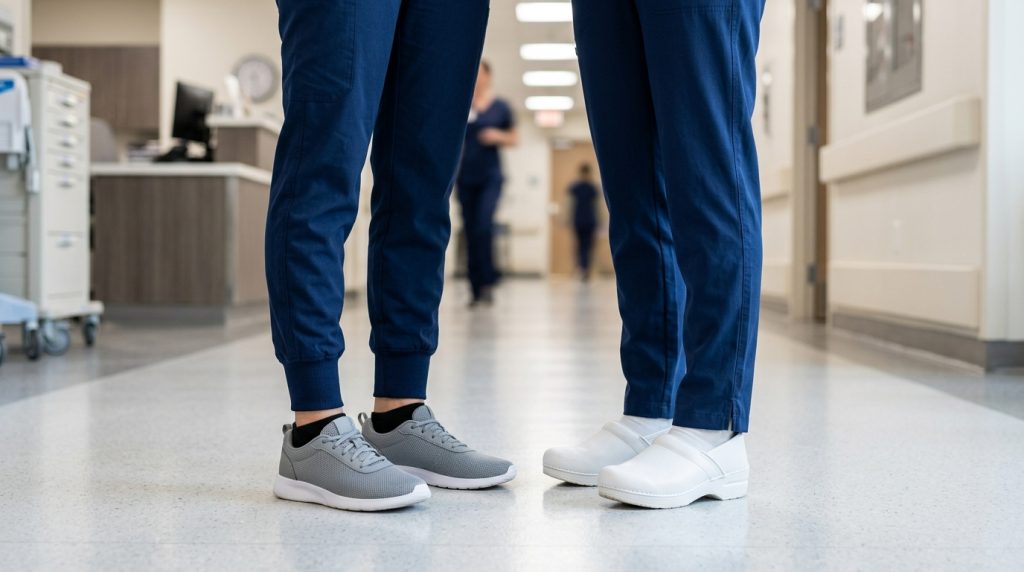
The main difference is usually the ankle treatment.
| Feature | Jogger Scrub Pants | Tapered Scrub Pants |
| Lower-Leg Shape | Narrow | Gradually narrow |
| Ankle | Usually fitted cuff | Standard hem |
| Overall Style | Athletic-inspired | Streamlined professional |
| Calf Fit | Often closer | Usually somewhat less restrictive |
| Inseam Appearance | Ends around cuff position | Falls toward shoe |
| Footwear Visibility | High | Moderate |
| Best For | Minimal ankle fabric | Modern shape without cuff |
Neither option is universally more comfortable.
A wearer with larger calves may prefer tapered pants, while someone who dislikes fabric near the shoe may prefer joggers.
What Are Cargo Scrub Pants?
Cargo scrub pants are designed around additional storage.
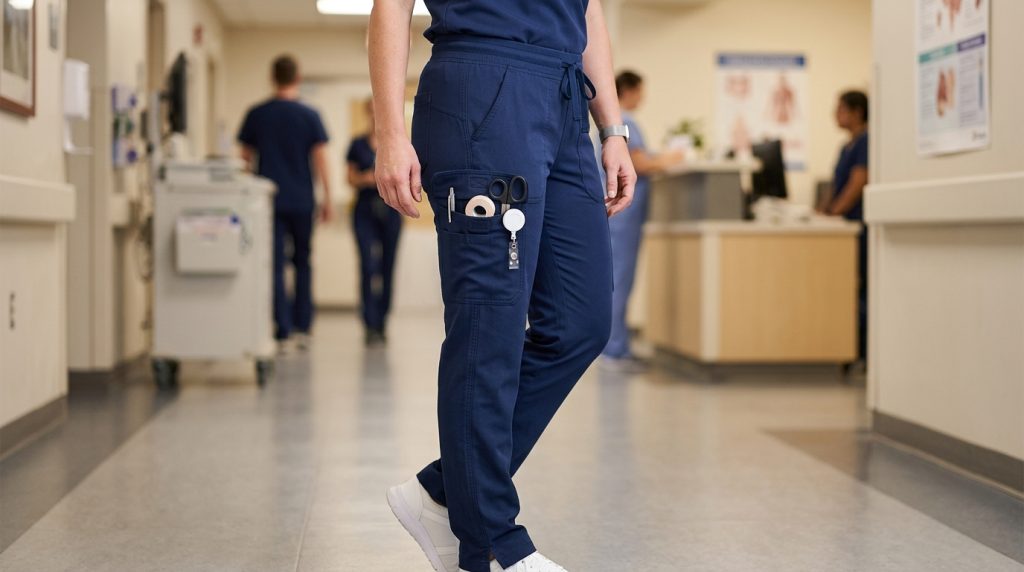
The defining feature is usually one or more large pockets positioned along the outer thigh.
Other storage may include:
- Front pockets
- Back pockets
- Zippered pockets
- Interior dividers
- Utility compartments
- Pen slots
Advantages of Cargo Scrub Pants
Cargo pants can be useful when a role requires several lightweight items to remain accessible.
Benefits may include:
- More storage capacity
- Separation of work items
- Easy thigh-level access
- Reduced need to overload scrub-top pockets
Potential Drawbacks
Extra pockets also add:
- Fabric
- Seams
- Weight
- Bulk
A heavily loaded cargo pocket may:
- Pull one side of the pants downward
- Swing against the leg
- Twist the pant seam
- Become uncomfortable while sitting
- Affect the waistband
- Stretch the fabric
The best cargo pant is not necessarily the one with the largest number of pockets.
Cargo Pocket Position Matters
A thigh pocket should remain accessible without sitting directly on a major pressure point.
Test it while:
- Sitting
- Walking
- Bending
- Climbing stairs
- Kneeling when appropriate
A pocket that works well while standing may become awkward in seated positions.
What Are Straight-Leg Scrub Pants?
Straight-leg scrub pants maintain a relatively consistent width from the thigh toward the hem.
They are one of the more traditional medical workwear silhouettes.
Advantages of Straight-Leg Scrub Pants
Straight-leg styles may provide:
- Additional calf room
- A traditional professional appearance
- Less fabric contact with the lower leg
- Compatibility with many footwear styles
- Easier fit for wearers who dislike narrow ankles
Potential Drawbacks
A wide straight leg can create more fabric around the lower leg than some professionals prefer.
If the inseam is too long, the hem may:
- Gather around footwear
- Drag
- Fold beneath the heel
- Create excess material behind the ankle
Accurate inseam selection is therefore particularly important.
Who May Prefer Straight-Leg Scrubs?
They may suit professionals who:
- Prefer classic workwear
- Have fuller calves
- Dislike tight pant legs
- Want unrestricted lower-leg movement
- Wear shoes that do not pair comfortably with ankle cuffs
What Are Flare Scrub Pants?
Flare scrub pants fit more closely through the upper leg and become wider below the knee.
Some designs use only a subtle flare, while others resemble a more pronounced bootcut silhouette.
Advantages of Flare Scrub Pants
Flare styles may provide:
- Additional calf and ankle room
- A balanced silhouette
- Less restriction below the knee
- Compatibility with certain footwear
- A professional apparel-inspired appearance
Potential Drawbacks
Flare pants require careful length selection.
Because the lower hem is wider, excess length can create:
- Dragging
- Fabric collecting around footwear
- Contact with the floor
- Uneven wear at the back hem
A flare should therefore be fitted while wearing the shoes commonly used at work.
Flare vs Straight-Leg Scrub Pants
Both styles provide more lower-leg room than a jogger, but their silhouettes differ.
Straight-leg pants maintain similar width through the lower leg.
Flare pants become progressively wider below the knee.
Straight-leg styles may be preferable for someone who wants a uniform width, while flare styles may work better for someone who prefers more shaping through the thigh.
What Are Wide-Leg Scrub Pants?
Wide-leg scrub pants provide generous room from the hips or thighs through the hem.
They have become more common as medical workwear incorporates broader apparel trends.
Possible Advantages
Wide-leg pants can provide:
- Generous lower-body room
- Reduced calf restriction
- A relaxed silhouette
- Air space around the legs
Possible Limitations
Excessively wide garments may create:
- More fabric movement
- Greater risk of incorrect hem length
- Additional material around footwear
- Bulk during active tasks
Workplace dress codes should also be considered before selecting highly fashion-oriented silhouettes.
Which Scrub Pant Style Provides the Most Movement?
Movement depends on both cut and fabric.
A relaxed straight-leg pant with minimal stretch may allow more movement than an undersized four-way-stretch jogger.
Important factors include:
- Hip ease
- Thigh width
- Rise
- Knee construction
- Stretch
- Stretch recovery
- Waistband stability
OSHA emphasizes that healthcare workers involved in patient handling should rely on appropriate safe-patient-handling programs, procedures, training, and equipment. Flexible scrub pants may improve clothing comfort during routine movement, but they do not replace safe patient-handling practices. (OSHA)
Perform a Movement Test
While wearing the pants:
- Sit fully in a chair.
- Stand without adjusting the waistband.
- Walk quickly.
- Bend at the knees.
- Raise one knee.
- Take several long steps.
- Climb a step when safe.
- Check the pants again.
The pants should remain secure without strong pulling through the rise, thighs, knees, or waistband.
Which Scrub Pant Style Is Best for Women?
There is no universal best style for women.
Body proportions vary widely, so waist-to-hip ratio, thigh shape, calf width, rise preference, and inseam should guide the decision.
Joggers May Work Well When:
- A defined ankle is preferred
- Calves fit comfortably inside the taper
- Athletic footwear is common
- Reduced lower-leg fabric is desirable
Tapered Pants May Work Well When:
- A streamlined silhouette is preferred
- A cuff is undesirable
- Moderate calf room is needed
Straight-Leg Pants May Work Well When:
- More lower-leg room is preferred
- Calves do not fit comfortably in narrow styles
- A traditional silhouette is desired
Flare Pants May Work Well When:
- More room below the knee is preferred
- A fitted upper leg feels comfortable
- The wearer wants a broader lower hem
Cargo Pants May Work Well When:
- Additional storage is a priority
- Scrub-top pockets are insufficient
- Thigh pockets remain comfortable during movement
Women should select the combination of style, rise, waistband, and inseam that fits their actual proportions rather than assuming one silhouette is designed for every female wearer.
Which Scrub Pant Style Is Best for Men?
Men may have different fit requirements through the waist, seat, thighs, rise, and lower leg.
Professionals shopping for scrub pants for men should evaluate the actual garment measurements and movement rather than relying only on a men’s size label.
Straight-Leg Pants
These are often useful for professionals who prefer:
- Traditional styling
- More calf room
- Easy footwear compatibility
Joggers
Men’s joggers may work well for those who prefer:
- Tapered lower legs
- Reduced ankle fabric
- Athletic-inspired styling
The calf and cuff should be checked carefully.
Cargo Pants
Cargo styles may be useful when work requires additional storage.
Heavily loaded thigh pockets should still be avoided.
Tapered Pants
Tapered cuts provide a middle ground between straight-leg and jogger silhouettes.
They may appeal to professionals who want less fabric without a cuff.
How Does Body Shape Affect Scrub Pant Choice?
General body-shape terminology can be useful, but actual measurements are more reliable.
Larger Waist-to-Hip Difference
Possible fit challenges include:
- Waistband gaps
- Tight hips
- Front pockets pulling
- Pants sliding downward
Possible solutions may include:
- Contoured waistbands
- Drawstrings
- Stretch panels
- More room through the hips
- A different rise
Fuller Thighs
Slim joggers and narrow tapered styles may pull through the thighs even when the waistband fits.
A relaxed tapered, straight, cargo, or selected flare style may provide more room.
Fuller Calves
Joggers can become restrictive below the knee.
Tapered or straight-leg pants may provide more lower-leg space.
Longer Legs
Tall lengths may be necessary, but the exact need depends on pant style.
A jogger cuff may intentionally sit above the shoe, whereas a straight or flare hem needs enough length to fall correctly over footwear.
Shorter Legs
Petite or short lengths may prevent:
- Excess ankle fabric
- Incorrect knee placement
- Dragging hems
- Improper flare position
How Does Pant Rise Interact With Style?
Two pants with the same leg shape can feel entirely different if their rises differ.
Low-Rise Pants
Low-rise styles sit lower on the torso.
They may provide a contemporary appearance but should be tested carefully while bending and sitting.
Mid-Rise Pants
Mid-rise pants are common because they provide a balance between lower and higher waistband placement.
High-Rise Pants
High-rise styles sit higher on the torso and may provide:
- Greater abdominal coverage
- A secure feeling at the waist
- Different proportions with tuckable tops
The waistband should not fold or create excessive pressure while seated.
Which Waistband Works Best With Each Style?
Joggers
Joggers commonly use:
- Full elastic
- Drawstring
- Elastic-and-drawstring combinations
- Knit waistbands
Because the lower leg is fitted, the waistband must remain stable during movement.
Tapered Pants
Almost any waistband can work with tapered pants.
Choice should depend primarily on:
- Body proportions
- Pocket weight
- Rise preference
- Desired adjustability
Cargo Pants
Cargo styles may benefit from a secure waistband because loaded thigh pockets can add weight.
A drawstring-and-elastic combination may provide useful adjustability.
Straight-Leg Pants
Full elastic, drawstring, knit, and hybrid waistbands can all work effectively.
Flare Pants
A wide knit or contoured waistband may complement the fitted upper portion, but comfort matters more than appearance.
How Do Pockets Change the Fit of Scrub Pants?
Pocket configuration can change both silhouette and comfort.
Common scrub-pant pockets include:
- Front slash pockets
- Back patch pockets
- Cargo pockets
- Zippered pockets
- Interior compartments
- Small utility pockets
Front Pockets
Front pockets are easy to access but may gape when the hips or rise are too tight.
Back Pockets
Objects stored in back pockets can become uncomfortable while sitting.
Bulky items should generally be relocated.
Cargo Pockets
Cargo pockets offer substantial storage but place weight along the thigh.
Zippered Pockets
Zippered pockets can secure small items but should not sit where the hardware presses against the leg.
Pocket Weight Should Remain Limited
The waistband and fabric should not be expected to carry significant equipment weight.
If the pants sag or rotate after items are added, storage should be redistributed.
Which Pant Style Works Best With Different Shoes?
Athletic Shoes
Most pant silhouettes can work with athletic footwear.
Joggers make the shoe highly visible, while straight and flare styles cover more of the upper shoe.
Clogs
Tapered and straight-leg pants commonly pair easily with clogs because they provide a conventional hem.
Jogger cuffs should be checked to ensure the proportions remain comfortable.
Slip-On Work Shoes
Straight, tapered, and jogger styles may all work depending on hem length.
Larger Work Footwear
Wide hems such as flare or straight-leg designs may fit more naturally over bulkier shoes.
Whatever the footwear, the pant should not:
- Drag beneath the heel
- Catch under the shoe
- Restrict ankle movement
- Bunch excessively
How Should Inseam Be Chosen for Each Style?
Inseam requirements change with silhouette.
Jogger Inseam
Joggers typically finish at or near the ankle.
A slightly shorter appearance may be intentional, but the cuff should not ride excessively high during sitting.
Tapered Inseam
Tapered pants should generally fall cleanly toward the top of the shoe without heavy bunching.
Straight-Leg Inseam
Straight-leg pants usually require enough length to reach the shoe while remaining clear of the floor.
Flare Inseam
Flare pants require particular care because the wider hem can drag easily.
Always check flare length with normal work footwear.
Cargo Inseam
Cargo refers to storage rather than leg shape, so cargo pants may also be jogger, tapered, or straight-leg.
Select inseam according to the underlying leg silhouette.
How Does Fabric Change Scrub Pant Performance?
The Federal Trade Commission requires certain textile products sold in the United States to disclose constituent fiber information, along with other required labeling details. Fiber content is useful when comparing scrub fabrics, although it does not fully describe weight, stretch, drape, or construction. (Federal Trade Commission)
Common fibers include:
- Polyester
- Cotton
- Rayon or viscose
- Nylon
- Spandex or elastane
Stretch Fabric
Stretch can be especially useful in:
- Joggers
- Slim tapered pants
- Fitted flare styles
- Pants with narrow thighs
The fabric should recover instead of remaining stretched at the knees or seat.
Structured Fabric
Structured material may support:
- Cargo pockets
- Straight-leg shapes
- Professional tailoring
However, a rigid fabric requires adequate ease through the hips and knees.
Lightweight Fabric
Lightweight material may feel less bulky, but pockets should be tested because heavier items may cause sagging.
Soft Draping Fabric
Soft fabrics can provide fluid movement but may emphasize pocket weight or lose a sharply defined silhouette.
How Should Scrub Pants Be Tested Before Buying?
A proper fitting should simulate normal movement.
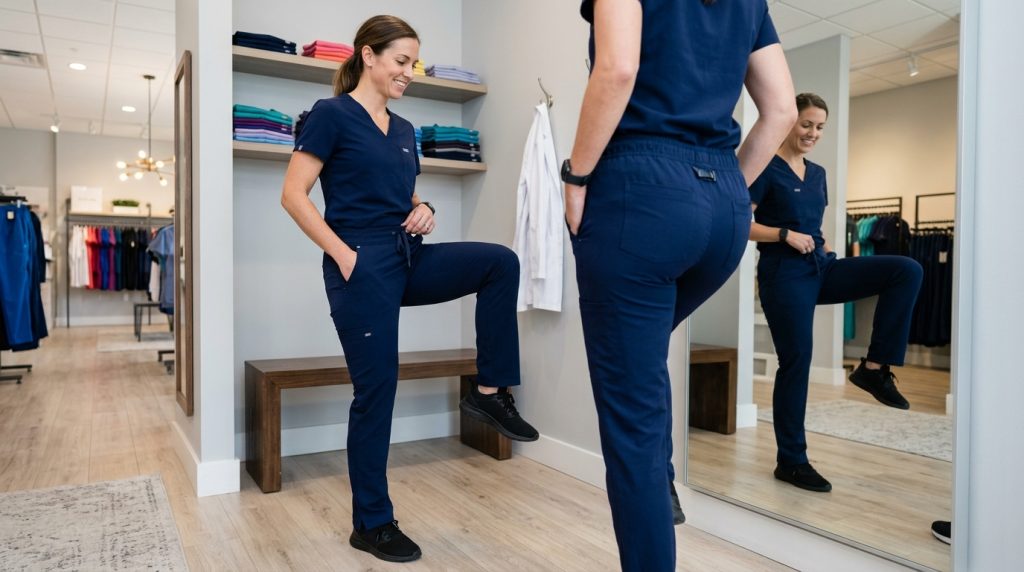
The Scrub Pant Fit Test
Wear normal work underlayers and footwear.
Then:
- Stand naturally.
- Sit fully in a chair.
- Cross one leg when appropriate.
- Stand without pulling the waistband up.
- Walk quickly.
- Bend at the knees.
- Raise one knee.
- Take a long step.
- Place normal lightweight items in the pockets.
- Check the hem and waistband again.
Check the Waist
The waistband should not:
- Roll
- Slide
- Dig into the body
- Require repeated tightening
Check the Rise
The rise should not:
- Pull while sitting
- Hang excessively low
- Create pressure
- Reduce coverage when bending
Check the Thighs and Knees
The fabric should allow movement without remaining under strong tension.
Check the Lower Leg
For joggers and tapered pants, confirm calf comfort.
For straight and flare pants, check excess fabric.
Check the Hem
The hem or cuff should remain clear of the floor and work comfortably with the intended shoes.
Professionals who want to compare several silhouettes before ordering can use an in-person scrub store in Lincoln to evaluate different rises, leg shapes, inseams, and fabrics.
Should Scrub Pants Fit Tight or Loose?
Scrub pants should provide functional ease.
They are probably too tight when:
- The waistband digs in
- Horizontal tension lines appear
- The pockets pull open
- The knees feel restricted
- Sitting creates pressure
- The fabric remains stretched while standing
They may be too loose when:
- The waistband slides
- The crotch hangs excessively low
- Fabric collects heavily behind the knees
- The pants rotate during walking
- The hem drags
- Pockets hang away from the body
The correct fit provides enough room without excessive material.
How Should Scrub Pants Be Cared For?
Always follow the garment’s care label.
Routine care considerations may include:
- Emptying all pockets
- Closing zippers when recommended
- Separating colors
- Using the stated wash temperature
- Following bleach restrictions
- Observing dryer instructions
- Inspecting elastic and drawstrings
FTC rules require manufacturers and importers of covered apparel to provide regular care instructions to purchasers. (Federal Trade Commission)
Incorrect care can affect:
- Waistband elasticity
- Fabric recovery
- Pant dimensions
- Surface texture
- Color
- Pocket shape
Workplace procedures should also be followed when they establish specific handling requirements for workwear.
Common Scrub Pant Buying Mistakes
Choosing by leg style alone
A preferred jogger or flare silhouette will not work if the rise, waist, or thigh dimensions are wrong.
Assuming all joggers fit the same
Jogger calf width, cuff size, rise, and taper vary.
Ignoring the inseam
Incorrect length affects every silhouette differently.
Buying cargo pants for maximum storage
Unused cargo pockets only add fabric and seams.
Overloading pockets
Weight can distort the pants and make the waistband less secure.
Choosing stretch instead of the correct size
Stretch cannot compensate for an incorrect rise or insufficient hip room.
Testing only while standing
Many fit problems become apparent only while sitting or bending.
Selecting the same size across every collection
Measurements and proportions can vary among manufacturers and styles.
Ignoring footwear
The correct hem length should be evaluated with normal work shoes.
Which Scrub Pant Style Is Best for Different Priorities?
| Priority | Style Worth Considering | Why |
| Minimal Fabric at Ankle | Jogger | Fitted cuff keeps lower leg streamlined |
| Modern Professional Shape | Tapered | Narrow silhouette without athletic cuff |
| Maximum Pocket Storage | Cargo | Additional thigh compartments |
| Classic Fit | Straight Leg | Traditional silhouette with calf room |
| More Room Below Knee | Flare/Bootcut | Wider lower leg |
| Relaxed Lower Body | Wide Leg | Generous leg opening |
| Fuller Calves | Straight or Flare | Less lower-leg restriction |
| Athletic Footwear | Jogger or Tapered | Streamlined around shoe |
| Mixed Footwear | Straight or Tapered | Versatile conventional hem |
This table should serve as a starting point, not a substitute for individual fitting.
How to Build a Practical Scrub Pant Rotation
Healthcare professionals do not necessarily need every pant style.
A practical rotation may contain:
- A preferred everyday style
- A higher-storage option
- A lighter or looser style for different work conditions
- A backup pair
- The correct lengths for different footwear when needed
After finding a successful pant, record:
- Brand or collection
- Product style
- Size
- Rise
- Inseam
- Leg shape
- Waistband
- Fabric blend
- Preferred pocket layout
- Approved work color
This makes future ordering more consistent.
Conclusion
Jogger, tapered, cargo, straight-leg, and flare scrub pants each solve different fit and function preferences.
Joggers reduce fabric at the ankle.
Tapered pants provide a streamlined shape without a cuff.
Cargo pants prioritize accessible storage.
Straight-leg pants offer a classic silhouette and greater lower-leg room.
Flare pants provide a fitted upper leg with additional room below the knee.
The most important decision is not which style is currently popular. It is which combination of waistband, rise, hip room, thigh fit, knee movement, inseam, pockets, fabric, and leg shape works best throughout the actual workday.
A scrub pant should remain comfortable when the wearer moves, not just when standing in front of a mirror.
Frequently Asked Questions
Are jogger scrub pants better than straight-leg scrub pants?
Neither is automatically better. Joggers provide a fitted ankle and reduced lower-leg fabric, while straight-leg pants provide more calf room and a traditional silhouette. The better option depends on body proportions, footwear, and fit preference.
What is the difference between jogger and tapered scrub pants?
Both narrow toward the ankle, but joggers usually end in an elastic or knit cuff. Tapered scrub pants generally use a conventional hem and gradually narrow through the lower leg.
Are cargo scrub pants good for nurses?
Cargo pants can be useful when nurses need accessible thigh-level storage for permitted lightweight items. However, overloaded cargo pockets can pull on the waistband, twist the pant leg, and become uncomfortable while walking or sitting.
Which scrub pants are best for large calves?
Straight-leg, relaxed tapered, flare, or selected wide-leg styles generally provide more lower-leg room than slim joggers. Actual calf and leg-opening measurements should be checked because fit varies among products.
Should scrub pants be tight or loose?
Scrub pants should provide functional room without excessive fabric. They should allow sitting, walking, bending, and knee movement without strong pulling, but they should remain secure enough that the waistband and pant legs do not shift continuously.
Are flare scrub pants appropriate for healthcare workers?
Flare scrub pants can be suitable when permitted by workplace dress standards and fitted to the correct length. The wider hem should stay clear of the floor and footwear.
Do jogger scrub pants need a shorter inseam?
Joggers often appear shorter because the cuff ends around the ankle rather than falling over the shoe. The correct inseam depends on the garment design, rise, leg length, and preferred cuff position.
Which scrub pant style has the most pockets?
Cargo scrub pants generally provide the greatest number of storage areas, particularly thigh pockets. Pocket count varies by design, however, and more pockets do not necessarily make a pant more practical.