

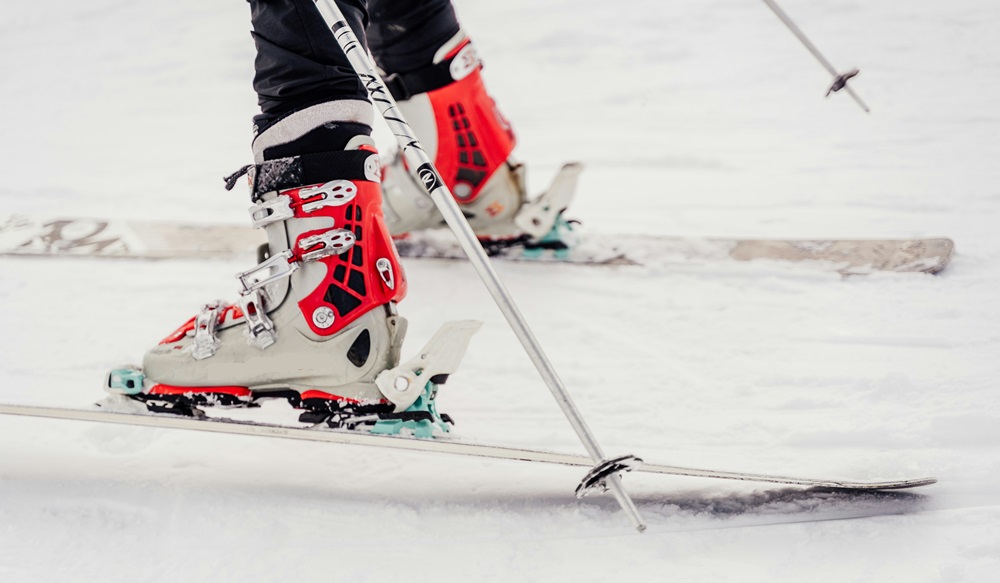
Every ski boot has a number printed on the shell, and that number shapes how the boot feels more than almost anything else. If you’re shopping for downhill ski boots, it tells you how much force it takes to bend the boot forward.
A soft boot bends easily. A stiff boot pushes back hard.
Pick the wrong one and you’ll either feel stuck in a plank or lose control at speed. This guide shows how flex ratings line up with your skill level, your weight and the way you ski.
TL;DR on Downhill Ski Boots Flex Ratings
Here’s the short version before the details:
- Flex is a number that shows how stiff a boot is.
- Beginners usually do best between 50 and 90.
- Advanced skiers often move up to 110 to 130.
- Heavier skiers usually need a stiffer boot than lighter skiers at the same level.
- The numbers are not standardized, so try the boot on before you trust it.
What a Flex Rating Tells You
The flex rating is a rough measure of how much resistance the boot gives when you press your shin into the tongue. A low number means a soft, forgiving boot. A high number means a stiff boot that responds fast.
Brands don’t measure flex the same way. A 100 from one maker can feel softer or stiffer than a 100 from another.
Use the number as a starting point, then check how the boot actually feels on your foot.
Flex Rating by Skill Level
Charts from different retailers don’t match exactly, but they follow the same pattern. Here are the typical ranges:
- Entry level: 50 to 70. These boots are soft and easy to flex.
- Beginner to intermediate: 80 to 100. They balance comfort and control.
- Advanced: 110 to 130. They give stronger response at speed and on steep runs.
- Expert and race: 130 and up. They are built for skiers who drive the boot hard.
Some charts push the beginner range a little lower, around 60 to 80, for skiers who make slow wedge turns.
How Your Weight Changes the Number
Skill level is only half of the answer. Two skiers of the same ability, one at 140 pounds and one at 200 pounds, will feel the same 110 flex boot very differently.
Heavier skiers put more force into the boot, so they often need more stiffness. Lighter skiers usually do better in softer boots.
Women’s boots also tend to carry lower flex ratings for the same level of skiing. That reflects differences in weight and leg strength, so don’t read a lower number as a lower skill rating.
How Your Skiing Style Affects Flex
Style matters as much as ability. Race technique and hard groomed runs call for stiffer boots. Park skiing and variable snow call for a boot with a bit more give.
Two skiers who both rate themselves as advanced can land on different numbers for this reason.
Why Temperature Changes How a Boot Feels
Flex ratings are measured at room temperature. Most boot plastics stiffen in the cold, so a boot that feels right in the shop can feel noticeably firmer on a cold chairlift morning.
If you ski in very cold places, lean toward the softer end of your range.
Common Flex Mistakes to Avoid
The most common mistake is buying a boot that’s too stiff. A boot you can’t flex won’t let you bend your ankles and knees, and that makes skiing harder.
Watch for these other slip ups:
- Buying on ego: A higher number looks serious but only helps if you can drive the boot.
- Ignoring fit: A boot with the right flex still feels bad if the shell is the wrong size or width.
- Trusting the number alone: Try the boot and flex forward in it before you decide.
Checking Flex When You Buy New or Used
The same rules apply to used boots. Check the shell for cracks and the liner for wear, then confirm the flex rating on the boot matches the one in the listing.
Marketplaces such as Geartrade list new and used alpine boots, so you can compare flex ratings and sizes in one place before you commit.
FAQ
These are some questions skiers ask once they know their number:
What Flex Is Best for a Beginner?
Most beginners do well between 50 and 90. A softer boot is easier to control at low speeds.
Do Heavier Skiers Need a Stiffer Boot?
Usually, yes. More body weight puts more force on the boot, so a stiffer flex keeps it from collapsing.
Are Women’s Ski Boots Softer?
Women’s boots generally have lower flex ratings for the same skill level. The difference comes from average weight and leg strength.
Do Ski Boots Feel Stiffer in the Cold?
They do. Boot plastic gets firmer as the temperature drops, while ratings are set at room temperature.
Is a Higher Flex Rating Always Better?
No. A boot that’s too stiff for you is harder to control and more tiring to ski in.
Conclusion
Flex is a useful guide, but it only works when it matches you. Start with your skill level, adjust for your weight and style, and expect some difference between brands.
Then put the boots on and flex forward. If you can bend them with control, you’ve found your number.