


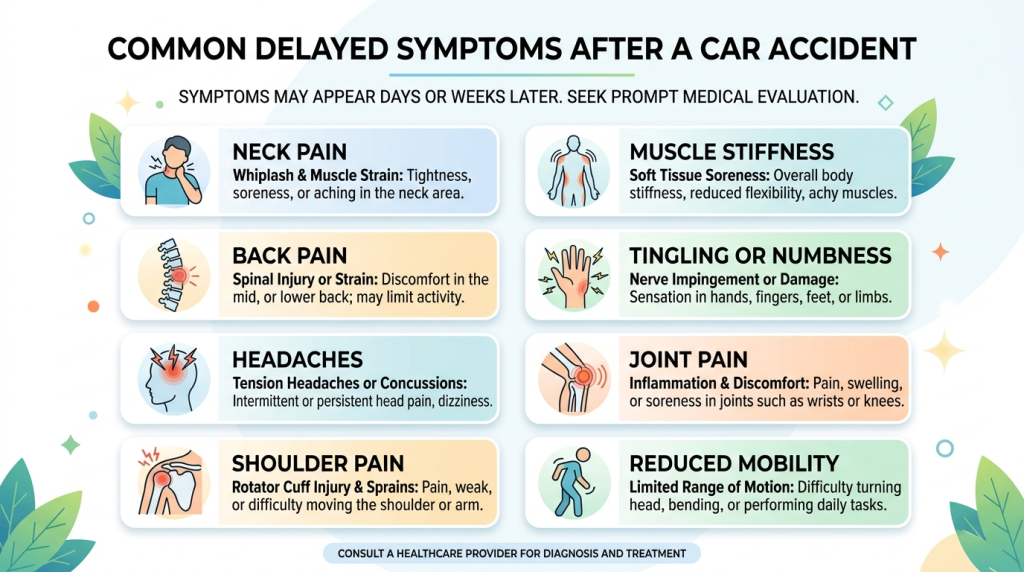
After an auto accident, pain does not always appear right away. You may feel okay at the crash scene, then begin noticing neck pain, back pain, headaches, stiffness, soreness, shoulder discomfort, joint pain, or reduced mobility hours or days later.
This delay can make accident injuries confusing. Many people wonder whether the pain is normal, whether it will go away on its own, or whether they should get evaluated.
Chiropractic care after an auto accident focuses on evaluating accident-related pain, improving mobility, supporting soft tissue recovery, documenting symptoms, and helping patients return to daily activities with a structured recovery plan.
For patients seeking accident & injury chiropractic care in Fort Worth after a crash, Premier Injury Clinics of DFW’s Fort Worth/Haltom City location provides accident-focused chiropractic care, rehabilitation therapy, same-day injury evaluations when available, and structured recovery support.
Quick Answer
Chiropractic care may help after an auto accident by addressing neck pain, back pain, whiplash symptoms, headaches, soft-tissue soreness, joint discomfort, stiffness, and reduced mobility. Care may include chiropractic treatment, rehabilitation therapy, mobility exercises, soft tissue support, documentation, and progress monitoring.
Because accident symptoms may appear hours or days after a crash, early evaluation can help identify injury patterns and guide a recovery plan before symptoms become harder to manage.
The U.S. Department of Transportation explains that post-crash care is an important part of helping injured people receive timely medical attention after serious crashes.
If symptoms are severe, worsening, or include loss of consciousness, confusion, repeated vomiting, chest pain, trouble breathing, weakness, numbness, or severe headache, seek emergency medical care immediately.
Key Takeaways
- Auto accident injuries can appear hours or days later, especially neck pain, back pain, headaches, stiffness, soreness, and reduced mobility.
- Chiropractic care may help evaluate musculoskeletal symptoms resulting from collision forces.
- Treatment may include chiropractic care, rehabilitation therapy, soft tissue support, mobility work, and progress monitoring.
- Early evaluation may help document symptoms and create a structured recovery plan.
- Premier Injury Clinics of DFW’s Fort Worth/Haltom City location serves Fort Worth, Haltom City, North Richland Hills, Saginaw, White Settlement, and nearby Tarrant County communities.
Why Auto Accidents Can Cause Hidden Injuries
An auto accident can place sudden force on the body. Even a lower-speed crash can affect the neck, back, spine, joints, muscles, ligaments, and soft tissues.
The body may be injured by:
- Sudden stopping force
- Rapid forward-and-backward movement
- Twisting during impact
- Bracing before the crash
- Seatbelt restraint
- Airbag deployment
- Side-impact force
- Muscle tightening during collision
These forces can create pain even when there are no visible injuries. That is why someone may walk away from a crash feeling fine, then wake up the next day with stiffness, soreness, or headaches.
How Chiropractic Care Helps After a Crash
Chiropractic care after an auto accident is designed to evaluate how the crash affected the body and help support recovery through a structured plan.
1. It Helps Identify Accident-Related Symptoms
An accident-focused evaluation can help connect symptoms to the collision. This may include reviewing how the crash happened, when symptoms started, and how pain affects daily activities.
Symptoms that may need evaluation include:
- Neck pain
- Back pain
- Headaches
- Shoulder pain
- Knee pain
- Muscle tightness
- Joint discomfort
- Tingling or numbness
- Reduced range of motion
- Pain while sitting, standing, walking, or driving
2. It Supports Neck and Back Mobility
Neck and back pain are common after auto accidents. Stiffness can make it difficult to turn the head, check blind spots, sit at work, sleep comfortably, or lift everyday items.
Chiropractic care may help address joint and spinal mobility problems after a crash. As mobility improves, patients may be able to return to their daily routines more comfortably.
3. It Can Help With Whiplash-Related Symptoms
Whiplash is common after rear-end collisions. It happens when the neck moves quickly forward and backward, placing stress on muscles, ligaments, joints, and soft tissues.
Mayo Clinic describes whiplash as a neck injury caused by forceful, rapid back-and-forth movement of the neck. Symptoms may include neck pain, stiffness, headaches, shoulder or upper back pain, reduced range of motion, tingling, tiredness, and dizziness.
Whiplash-related symptoms may include:
- Neck pain
- Neck stiffness
- Headaches
- Shoulder discomfort
- Upper back tightness
- Trouble turning the head
- Pain that worsens with neck movement
- Tingling or numbness in the arms
Because whiplash symptoms may begin within days, neck pain and headaches after a crash should be monitored carefully.
4. It Supports Soft Tissue Recovery
Soft tissue injuries affect muscles, ligaments, and tendons. These injuries may not always be obvious right away, but they can cause soreness, swelling, tenderness, tightness, bruising, and reduced mobility.
Soft tissue-focused care may help support comfort, movement, and range of motion during recovery.
5. It Helps Build a Structured Recovery Plan
Without an evaluation, many accident victims guess what to do next. Some rest too much. Others return to work, driving, lifting, or exercising too quickly.
A structured recovery plan may include:
- Accident injury evaluation
- Chiropractic care
- Rehabilitation therapy
- Soft tissue support
- Mobility exercises
- Stretching
- Strengthening
- Activity modification
- Progress monitoring
- Follow-up visits
The plan should be based on the patient’s symptoms, injury type, mobility limitations, and recovery progress.
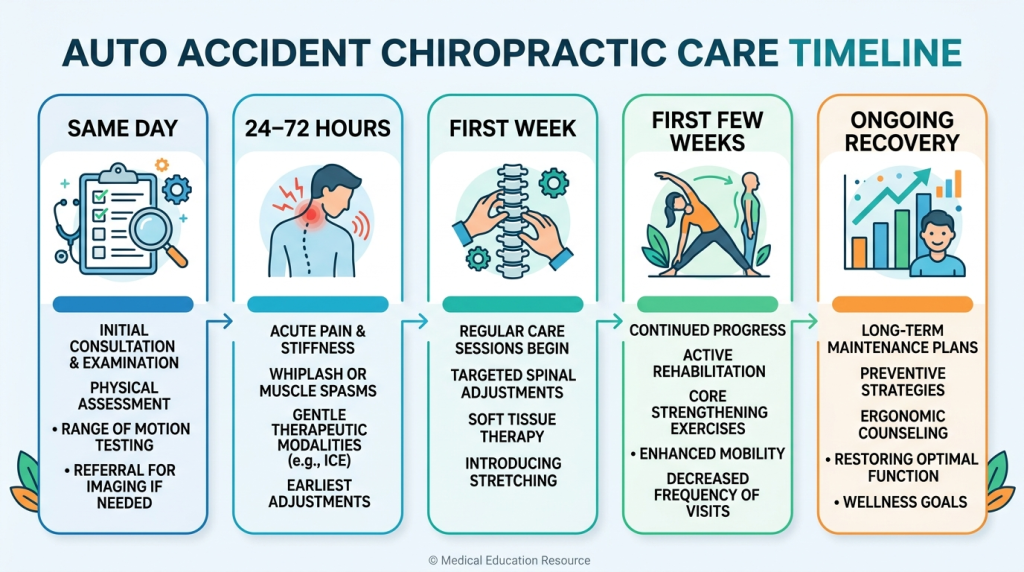
Auto Accident Chiropractic Care Timeline
Every patient’s recovery is different. The timeline depends on the crash, symptoms, injury severity, health history, daily activity needs, and how quickly care begins.
| Time After Accident | What You May Notice | Helpful Next Step |
| Same day | Shock, soreness, or little pain because adrenaline may mask symptoms. | Focus on safety, document symptoms, and seek emergency care for serious warning signs. |
| 24–72 hours | Neck pain, back pain, headaches, stiffness, or soreness may appear. | Schedule an accident injury evaluation if symptoms develop. |
| First week | Inflammation, tightness, and reduced mobility may become more noticeable. | Begin a structured recovery plan if recommended. |
| First few weeks | Symptoms may improve, shift, or flare with activity. | Stay consistent with care and report any changes in symptoms. |
| Ongoing recovery | Some injuries may require continued rehabilitation and progress monitoring. | Follow the care plan and avoid rushing full activity. |
The main point is simple: delayed pain after an auto accident should not be ignored.
What Treatment May Include
Auto accident chiropractic care may include several types of support depending on the patient’s condition.
Accident Injury Evaluation
An evaluation may include a discussion of the crash, a review of symptoms, range-of-motion checks, pain assessment, and an evaluation of how symptoms affect work, driving, sleep, and daily activities.
Chiropractic Care
Chiropractic care may help address spinal and joint mobility issues after impact. This can be important when pain or stiffness affects the neck, back, shoulders, hips, or other joints.
Rehabilitation Therapy
Rehabilitation therapy may include guided exercises, stretching, strengthening, stability work, and movement retraining to help restore function after an injury.
Soft Tissue Support
Soft tissue support may help reduce tightness, improve comfort, and support the range of motion in muscles, ligaments, and tendons affected by the crash.
Progress Monitoring
Recovery can change from week to week. Progress monitoring helps determine whether symptoms are improving and whether the care plan should be adjusted.
Why Local Fort Worth Care Matters
After an auto accident, local access can make recovery easier. Some patients need multiple visits, follow-up evaluations, and rehabilitation therapy. A nearby clinic can help patients stay consistent with care.
Premier Injury Clinics of DFW’s Fort Worth/Haltom City location serves patients from:
- Fort Worth
- Haltom City
- North Richland Hills
- Saginaw
- White Settlement
- Benbrook
- Watauga
- Richland Hills
- Nearby Tarrant County communities
The Fort Worth-area clinic is located at:
2108 Harris Ln, Suite 200
Haltom City, TX 76117
This location may be helpful for patients who live, work, or commute near I-35W, Loop 820, I-30, SH 121, SH 183, Beach Street, Denton Highway, Harris Lane, and surrounding Fort Worth-area roads.
Transportation assistance may be available for qualifying patients recovering after a car accident, which can be helpful if the vehicle was damaged or driving is uncomfortable.
Red Flags: When to Seek Emergency Care First
Chiropractic care and rehabilitation therapy may help many accident-related musculoskeletal injuries, but some symptoms require emergency medical attention.
The CDC lists danger signs after a possible traumatic brain injury, including worsening headache, repeated vomiting, weakness, numbness, seizures, slurred speech, confusion, unusual behavior, unequal pupils, or loss of consciousness.
Seek emergency care immediately if you experience:
- Loss of consciousness
- Chest pain
- Trouble breathing
- Severe or worsening headache
- Confusion
- Repeated vomiting
- Weakness on one side of the body
- Slurred speech
- Heavy bleeding
- Severe abdominal pain
- Severe neck or back pain after trauma
- Numbness or weakness in the arms or legs
- Loss of bladder or bowel control
When in doubt, choose emergency care first. Once serious conditions are ruled out, chiropractic care and rehabilitation may be part of the recovery process.
Frequently Asked Questions
How does chiropractic care help after an auto accident?
Chiropractic care may help evaluate accident-related pain, improve neck and back mobility, support soft tissue recovery, document symptoms, and guide a structured recovery plan.
Should I see a chiropractor if I feel fine after a crash?
You may not need treatment if you truly have no symptoms, but you should monitor your body carefully. Many symptoms appear hours or days later. If neck pain, back pain, headaches, stiffness, soreness, numbness, tingling, or reduced mobility develop, consider scheduling an evaluation.
What symptoms should I watch for after an auto accident?
Watch for neck pain, back pain, headaches, shoulder pain, knee pain, stiffness, soreness, tingling, numbness, joint discomfort, reduced range of motion, and pain while sitting, standing, walking, or driving.
Can chiropractic care help with whiplash symptoms?
An accident-focused chiropractor may evaluate whiplash-related symptoms, including neck pain, stiffness, headaches, shoulder discomfort, reduced range of motion, and muscle tightness. Care may include chiropractic treatment, rehabilitation therapy, soft tissue support, and progress monitoring.
Why is early evaluation important after a crash?
Early evaluation may help identify hidden injuries, document accident-related symptoms, and begin a structured recovery plan before pain, stiffness, or mobility problems become harder to manage.
Does Premier Injury Clinics of DFW serve Fort Worth-area patients?
Yes. The Fort Worth/Haltom City location serves patients from Fort Worth, Haltom City, North Richland Hills, Saginaw, White Settlement, Benbrook, Watauga, Richland Hills, and nearby Tarrant County communities.
Is transportation available after a car accident?
Transportation assistance may be available for qualifying patients recovering after a car accident. Availability can vary, so patients should contact the Fort Worth/Haltom City clinic for details.
Final Thoughts
Chiropractic care may help after auto accidents by evaluating symptoms, supporting mobility, addressing soft tissue discomfort, documenting findings, and guiding patients through a structured recovery plan.
Neck pain, back pain, headaches, stiffness, soreness, and reduced mobility should not be ignored, especially when they appear hours or days after a crash or begin affecting daily life.
Premier Injury Clinics of DFW provides accident-focused chiropractic care, rehabilitation therapy, same-day evaluations when available, structured recovery plans, and transportation assistance for qualifying patients recovering after auto accidents in Fort Worth, Haltom City, and nearby Tarrant County communities.
Visit the Premier Injury Clinics of DFW Fort Worth location page to learn more about accident injury evaluations, chiropractic care, rehabilitation therapy, and recovery support after a car accident.