

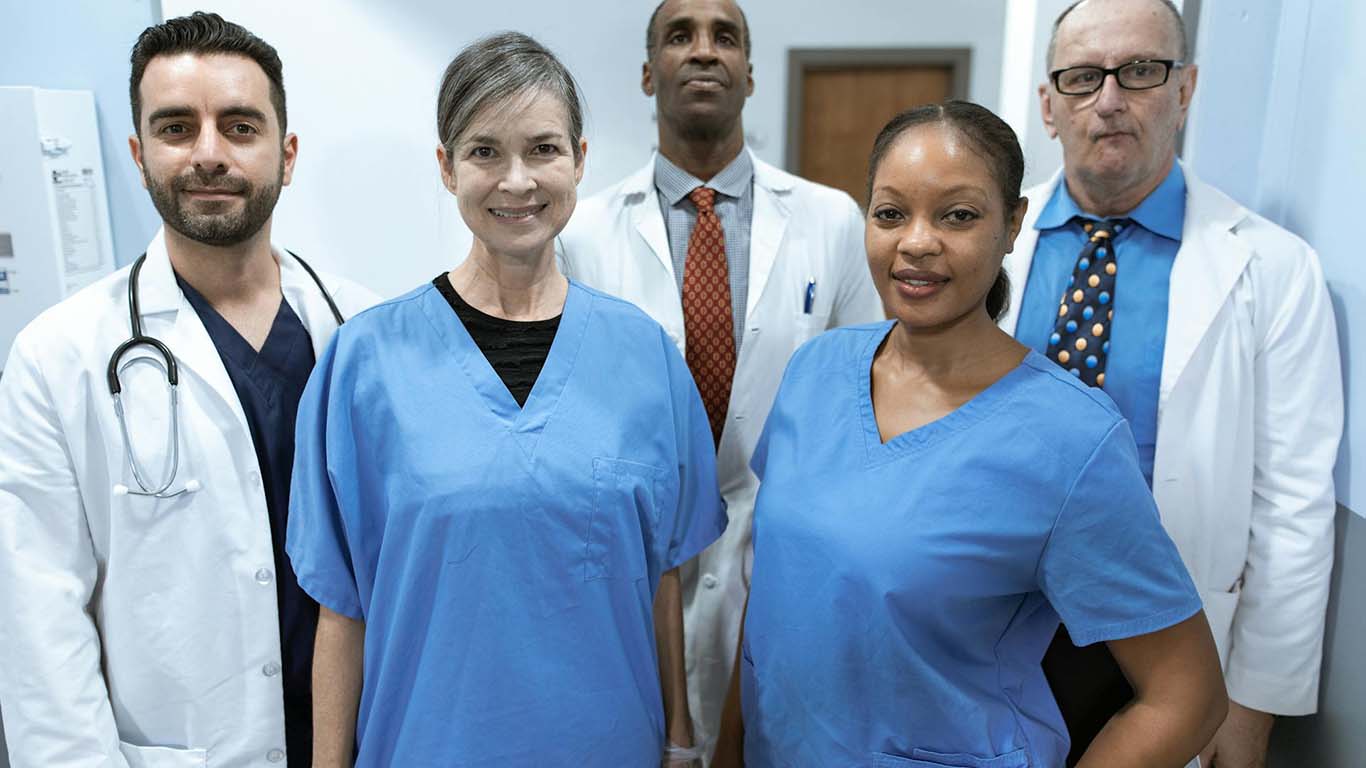
Healthcare conditions require attention, fastness and physical stamina. The professionals are continuously shuttling between the patients, equipment and departments sometimes on twelve hours or more shifts. The demands should be supported by uniforms in order to avoid distraction and discomfort.
Scrubs for healthcare professionals must be durable and flexible and helps medical professionals remain productive during the day. In the emergency departments, as well as outpatient clinics, appropriate work wear promotes performance and presentation.
Lightweight fabrics, strong sewing, and convenient carrying properties will put it into the traditional reliability. In cases where uniforms are carefully chosen, medical staff will be able to focus on providing care instead of fixing ill-fitting clothes or dealing with the irritation in a life-or-death situation.
Constructed To Move In High Mobility Environments
The healthcare professions demand a lot of bending, reaching, lifting and walking. The uniforms should be able to cover all-time movement without being limiting. Stretch blended fabrics give flexibility where there is high movement such as in shoulders, hips and knees.
Relaxed cuts and side vents ensure that they are not tight during prolonged work. The seam lines are not jagged, which helps them not to be irritable when they are worn long. Lightweight construction is made as light as possible and yet not fragile.
Mobility centered design also means that the professionals can move to the next patient room, procedure, and consultation fast. Feeling free to move around will help to channel the energy in patient care instead of dressing up and changing clothes during the shift.
Flexibility During Repeated Washing
Hygienic requirements have led to high frequencies of laundering medical apparel. The quality of fabric has a direct effect on the life cycle. Good stitching around pockets and seams will ensure that they fail to tear after repeated stress. The technology of color retention minimizes wasting following numerous wash cycles.
The shrink resistant materials assist in keeping the garments at the same size. High stress areas that are reinforced make life usable. Anti-wrinkle clothes have a smooth appearance and require little ironing.
By selecting the uniforms designed in such a way that they are durable, it is cost effective in the long run. Maintaining structure and color through professional medical uniforms help with a shift to a professional and confident workplace every shift.
Climate Control And Breathability
In hectic medical facilities, temperature management is necessary. At the same time, professionals are permitted to relocate between air conditioned rooms to the warmer ones. Moisture wicking is a type of technology that pulls out the moisture on the skin, which promotes the dryness and comfort of the skin.
Air-flow is promoted by breathable cotton blends. Mesh or ventilation panels augment circulation of air in hot areas. Mid weight are those that combine insulation and cooling.
Regulated temperature ensures reduction of fatigue due to overheating or discomfort. Climate responsive materials incorporated in the design will help the workers feel confident and have their focus in diverse clinical settings.
Intelligent Storage And Useful Design
Efficiency in everyday life is dependent on accessibility. Pockets that are placed strategically make uniforms more convenient to carry tools and other personal necessities. Deep pockets hold essentials like pens, notepads and small medical instruments.
Discreet storage is provided by means of hidden compartments. Badge loops and utility rings eliminate the use of clips, which can ruin fabric. The tactical pockets are placed in strategic positions to avoid bulk and retain clean lines.
Proper layout design enables medical workers to be able to carry their necessary things without being uncomfortable. Real-life uniform building enhances the efficiency of the working process even during hectic timetables.
Conclusion
When choosing work clothes, one should take into account the issue of comfort, durability, and functionality. Mobility friendly design enhances the continuous movement during the long shifts. Sustainable construction means that clothes do not change their shape or color during the repeated washing.
Porous fabrics control the heat and improve comfort on the daily basis. Good presentation brings about professionalism which builds trust and confidence among patients and colleagues.
Scrubs that are carefully chosen can be helpful to provide not only efficiency but also comfort to healthcare workers. Financing quality uniforms eventually promotes productivity, physical appearance, and long term satisfaction of the arduous medical profession.